
Debt Hunt Locations & Map
Landmark types and procedural layouts — what to look for on a fresh contract, not a memorized GPS pin.
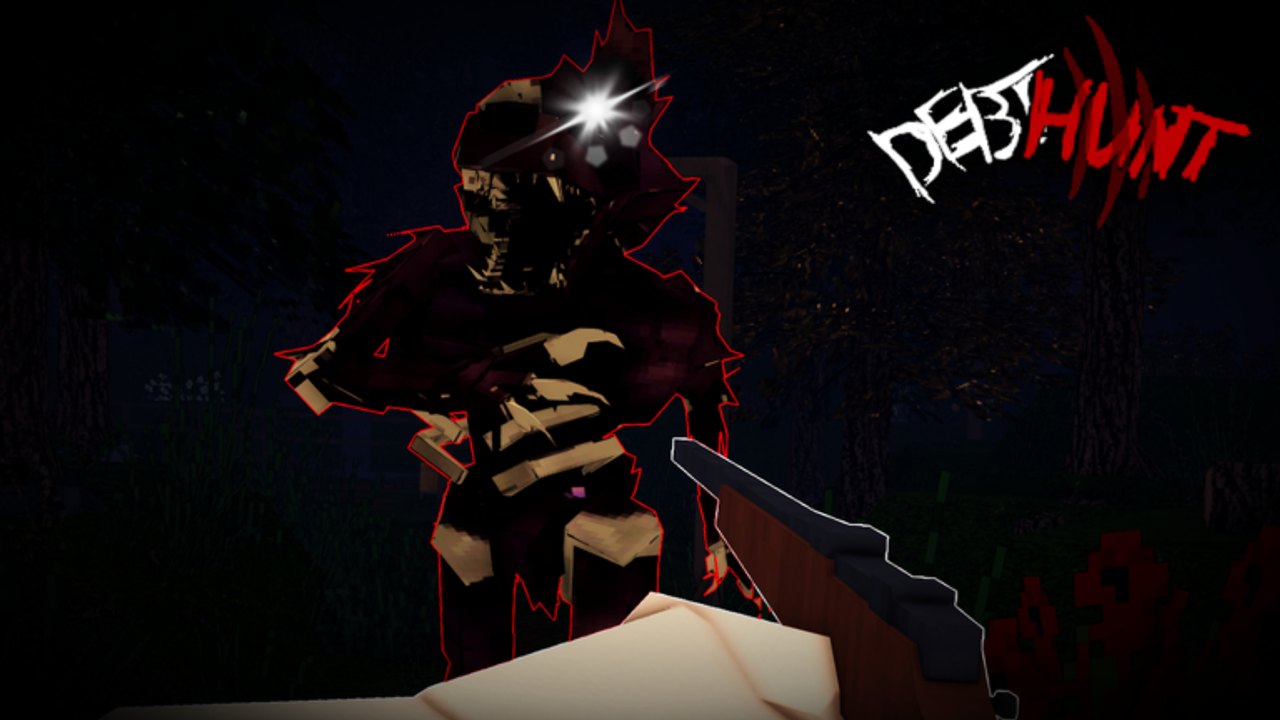
Debt Hunt drops every squad into a procedurally generated night forest with one goal: extract enough Cash to pay the Debt Hunt corporation before sunset and the monster become the same problem. Because the map rebuilds each contract, this page is a landmark catalog, not a static atlas. We group the world into the location types NZTeam and T0pH4t_Studios have shown in official media and the badge set, then explain what each one means for quota runs, sunset runs, and solo versus squad play.
If you arrived here looking for a YouTuber’s “Farm Map” or “Cage Map” pin, slow down. The forest rebuilds every contract — the only constant is the types of place you can find, not their coordinates. For the deeper survival math, jump to survive sunset, monster, and procedural maps.
What the map actually is
Debt Hunt is published on Roblox under universe 9063977758 (place 119116892854064) by T0pH4t_Studios. The Roblox experience description says it is “a game with a procedural generation, where your goal is to earn as much money as possible to pay off a debt owed to the ruthless corporation and collection agency known as ‘Debt Hunt.’” That procedural pitch is the rule for this whole page:
- Every contract rebuilds the forest.
- Landmarks rotate by type, not by name.
- Official stills show the landmark types: night forest, first-person gun, a wolf-shaped hunter with a bright eye, a caged interior fight, and a wounded carry.
- Any “named biome” you see on a fan Discord is a guess, not a pin.
The atlas below lists the landmark types the studio has confirmed by badge, by official still, or by reproducible behavior — and the play patterns that work in each.
Forest biome
The forest is the main surface layer of every contract. Official stills show dense trees, low ambient light after sunset, and a clear silhouette of the player against the canopy. Trees block sightlines for the wolf and for you, which is why night navigation matters.
- Daylight use. Sightline to the next landmark (watchtower, cabin, fence corner) before you commit. The forest is the corridor.
- Sunset use. Trees cover your silhouette but also hide the wolf. Move tree-to-tree, never across open ground.
- Night use. You cannot navigate by sight alone. Carry a light source or stay on a route you scouted in daylight.
The forest biome does not have a fan name the studio has confirmed. Anyone selling a “Forest Map PDF” is selling speculation.
Cabins (interior loot)
Cabins are the most common interior landmark. They appear as small wooden buildings scattered across the forest, with doorways, internal walls, and loot containers. Official stills and badge evidence confirm that:
- Cabins hold supply boxes that count toward Provision Master (150 opens).
- Interior plank walls can be broken with a crowbar for Wrecking Crew progress (100 planks broken).
- Cabins can spawn photo subjects — interior stills count toward Master Photographer.
- Cabins sometimes carry medical items (bandages) and small Cash stashes.
Treat each cabin as a small quota puzzle. If you have to choose between breaking walls and searching containers, search containers first; the value of boxes beats the time you save on a faster path. Crowbar the wall only if a teammate is downed inside and the route is blocked.
Ore caves
Ore caves are the second major interior landmark and the source of the Master Miner badge (500 ores mined). Official stills show ore clusters inside cave interiors and on cliff walls.
- Layout — a narrow opening, then a chamber with one to three ore clusters. Caves sometimes branch.
- Light — caves are dark. Without a light source, you cannot tell ore rock from wall rock after sunset.
- Time cost — a cluster takes five to ten seconds to clear. Deep branches cost more daylight than they return.
- Wolf risk — the wolf follows you into caves if you aggro it outside. Always check the entrance before you commit to a deep branch.
Mine the cluster nearest the entrance, then rotate to the next landmark. The deep branch is for Hard or Insane crews who already have a route.
Watchtowers
Watchtowers are elevated landmark types that appear at forest edges. Official stills show a wooden platform on stilts, often with a sightline across multiple biome chunks. Use them to:
- Confirm the direction of sunset before night falls.
- Spot fence corridors that lead to the next interior.
- Count ore cave openings in your grid (three to four per map is normal).
- Listen for the wolf before you drop down. Sound travels along corridors; the wolf will hear you if you jump.
Watchtowers are not loot landmarks. Treat them as the survey points between loot landmarks.
Fence corridors
Fence corridors are the broken-wood fencing that connects forest sections. They appear in official stills as a low wooden wall with gaps and broken planks. Practically:
- Fences funnel the wolf into a chokepoint. Trap placement along a fence is the senior move.
- Fence sections can be broken with a crowbar for a faster cross-country path.
- Fences sometimes hide treasure mounds at the corner where they change direction.
The fence line is the second-most reliable landmark in the forest after the cabin. If you are lost, walk the fence; it leads somewhere.
Extraction points (extract zones)
Extract zones are the end-of-day location type. You sell valuables here, deposit Cash toward the quota, and reset for the next contract day. Official stills show a fenced clearing with a deposit point and a small crowd of contractors.
- Solo extract — drop your valuables into the deposit, then either sprint out or hide. The wolf camps the extract if it aggroes during the deposit.
- Squad extract — one contractor drops while the rest hold a fence line or watchtower. Rotate the role every extract so no one is holding a wolf line alone.
- Empty extract — if no valuables are ready, the extract is a wasted trip. Use pay off the debt to decide when to walk.
If the wolf aggroes during your deposit animation, drop and crawl. The animation cannot be cancelled, but the deposit still counts.
Cage rooms
Cage rooms are interior landmarks that appear in official stills as a small fenced-off section inside a cabin or cave. They host a specific event: the wolf closes in on a trapped target. Badge evidence and official media suggest they are used for close-quarters combat scenarios, including the wolf-eye still image the studio published.
- Treat a cage room as a high-pressure, low-loot location. The value is in the badge progress (a cage clear counts toward combat badges), not the box drops.
- Squad composition matters here. If your medic is in the cage and your shooter is outside, you will lose the cage.
Campfires (rest landmarks)
Campfires are scattered landmarks in the forest. They restore a small amount of HP and stamina over time and are the only safe-spots between the cabin and the extract. Use them:
- After a wolf chase, to refill stamina before the next rotation.
- Before a final extract, so the deposit animation does not start at low HP.
- As a signal point for squad teammates. A lit campfire is a visible landmark; an unlit one is not.
Campfires are not a safe zone — the wolf can still find you if you linger.
What is not a confirmed location
The wiki will not publish:
- A named “Farm Map” or “Cage Map” pin set. The forest rebuilds.
- A specific biome tier list. The studio has not released a biome taxonomy.
- A hidden developer room. Update notes have not referenced one.
- A second map. The universe has one place.
If a future patch adds a new landmark type, this page is the second place it lands, after updates.
How to read a fresh contract
- First 60 seconds — find a watchtower or fence corner to set your orientation.
- First five minutes — log the nearest cabin and the nearest ore cave. Mark them mentally, do not draw a map.
- Day phase — run a cabin-to-cabin rotation. Open every supply box (Provision Master). Crowbar interior walls only on the way out.
- Sunset transition — finish your rotation inside a cabin or watchtower. Do not run for an extract you cannot see.
- Night phase — move on a fence line or stay in a lit interior. Wolf patrols the forest, not the fence.
- Extract — only when your bag is full enough to clear today’s quota math. Otherwise stay on the rotation and try again tomorrow.
Full day-clock math: how to play. Wolf posture after sunset: survive sunset. Squad role split when the cage drops: roles.
Locations and solo vs squad runs
- Solo — bias toward landmarks with the highest box density per minute (cabin interiors). Skip watchtowers unless you are lost. Avoid cages without a shooter role.
- Squad — split the map. One contractor on cabins, one on ore caves, one on the watchtower orientation, one carrying the medic kit. Rotate every two contracts so no role burns out.
Related pages
- Procedural Maps — why the forest rebuilds
- Structures — cabins, watchtowers, fence corridors, cage rooms in detail
- Wildlife — deer and rabbit habitats
- Survive Sunset — night posture inside landmarks
- Items — what you carry between landmarks
- Roles — squad split by landmark type
Frequently Asked Questions
Quick answers to the most common Debt Hunt questions.
Does Debt Hunt have a fixed map?
No. Every contract rebuilds the forest procedurally. The landmark **types** (cabins, ore caves, watchtowers, fence corridors, extraction points) stay the same, but their positions rotate. See procedural maps.
How many cabins are in a Debt Hunt contract?
The number rotates per contract. A typical mid-game forest has three to five cabins visible from a watchtower. The exact count is not published by NZTeam and varies with difficulty.
Where do I find ores?
Inside ore caves and on cliff walls near the forest edge. Caves are dark after sunset; bring a light source or mine during daylight. The Master Miner badge confirms 500 ores is the grind target.
Where is the extract point?
The extract zone is a fenced clearing where you deposit valuables toward the quota. Its position rotates per contract. Use a watchtower to find it before you commit your bag.
Are there named biomes?
No. NZTeam has not published a biome taxonomy. Anything labelled "Farm Map," "Cage Map," or "Snow Biome" by fans is a guess. The studio has shown the night forest, cabins, ore caves, watchtowers, and extraction points in official media.
Can I outrun the wolf in the forest?
Stamina lets you sprint short bursts. The wolf patrols corridors, not fence lines. Break line of sight at a fence corner and use a horn if you carry one. Full posture: survive sunset.